The 15-Year Mortgage Discount Is a Price for Time
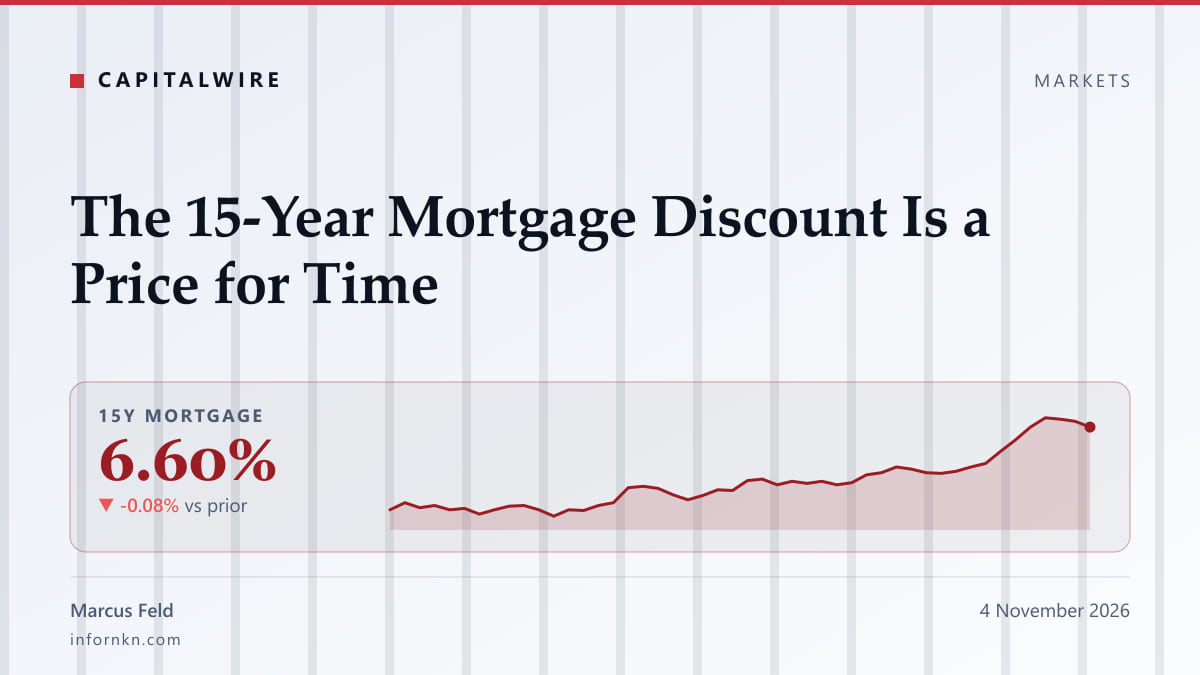
The 15-year averaged 6.60% against 7.24% for the 30-year. The long loan runs 0.64 percentage points higher, and that gap buys time.
In Freddie Mac's survey the 15-year fixed mortgage averaged 6.60% and the 30-year averaged 7.24%. The 30-year runs 0.64 percentage points above the 15-year. Same house, same borrower, same credit box — and the difference is not a discount for lower default risk. Both loans are sold to the same agencies under the same guarantee.
The gap is a price for time. Both loans carry a prepayment option: the borrower can refinance if rates fall, and the lender's return ends early exactly when the money was most valuable. A 15-year schedule returns principal twice as fast, so an investor in the security is exposed to that option for half as long. Less option value means a thinner spread over the Treasury curve, and the borrower receives the difference as a lower rate.
The relationship moved this year in the direction that explanation predicts. The 15-year is 114 basis points above its first survey of 2026 and the 30-year is 108 basis points above its own, so the gap narrowed slightly from the 0.71 percentage points it opened at. It has otherwise been steady: 0.61 in the survey dated 2026-09-24 and 0.64 in the survey dated 2026-10-22. For a number quoted to two decimals every Thursday, that is unusually steady, which makes it a useful check on claims about the mortgage market.
The discount does not arrive as a saving on its own. A 15-year schedule amortises the same principal over half the term, so the required monthly payment is materially higher even at the lower rate. The borrower buys a cheaper rate with a larger payment now, and whether that trade pays depends on facts the rate does not contain: how long the house is held, whether the difference in cash flow would have been invested, and whether the payment survives a bad year.
Stated honestly, the break-even is a cash-flow calculation and it needs a loan amount. That is why this page will not quote one. The mistake the spread invites is treating the shorter term as a discount on the same product. It is a different product: equity builds faster, payment flexibility is smaller, and the interest deducted over the life of the loan is lower because the balance is lower at every point.
What would break the time-price explanation: the 15-year trading above the 30-year for more than a survey or two. That has happened when the agency market for shorter paper seized and liquidity, rather than option value, set the price. If it recurs, the gap stops being a clean measure of duration and the reading above has to be replaced.
Elsewhere
- Primary Mortgage Market SurveyFreddie Mac
The survey behind both series. Published weekly on Thursdays, which is why the mortgage numbers move in weekly steps while Treasury yields move daily.
- 15-Year Fixed Rate Mortgage Average in the United StatesFRED
Weekly history back to 1991. The dates quoted above are survey dates, not the day the release appeared.
- 30-Year Fixed Rate Mortgage Average in the United StatesFRED
The long leg of every spread in this piece, measured on the same survey date as the 15-year rather than on the nearest available date.
Sources
- FRED series MORTGAGE15US, 15-Year Fixed Rate Mortgage Average, observed weekly; latest 2026-10-29; https://fred.stlouisfed.org/series/MORTGAGE15US
- FRED series MORTGAGE30US, 30-Year Fixed Rate Mortgage Average, observed weekly; latest 2026-10-29; https://fred.stlouisfed.org/series/MORTGAGE30US
- Freddie Mac Primary Mortgage Market Survey, methodology and weekly release schedule; https://www.freddiemac.com/pmms
More from CapitalWire

The Curve Never Inverted in 2026. It Flattened Anyway.
The 2s10s spread sits at 0.38%, 34 basis points narrower than on the first trading day of the year. Not one close in 2026 has been negative.
Why a Three-Month Bill Pays More Than the Fed's Rate
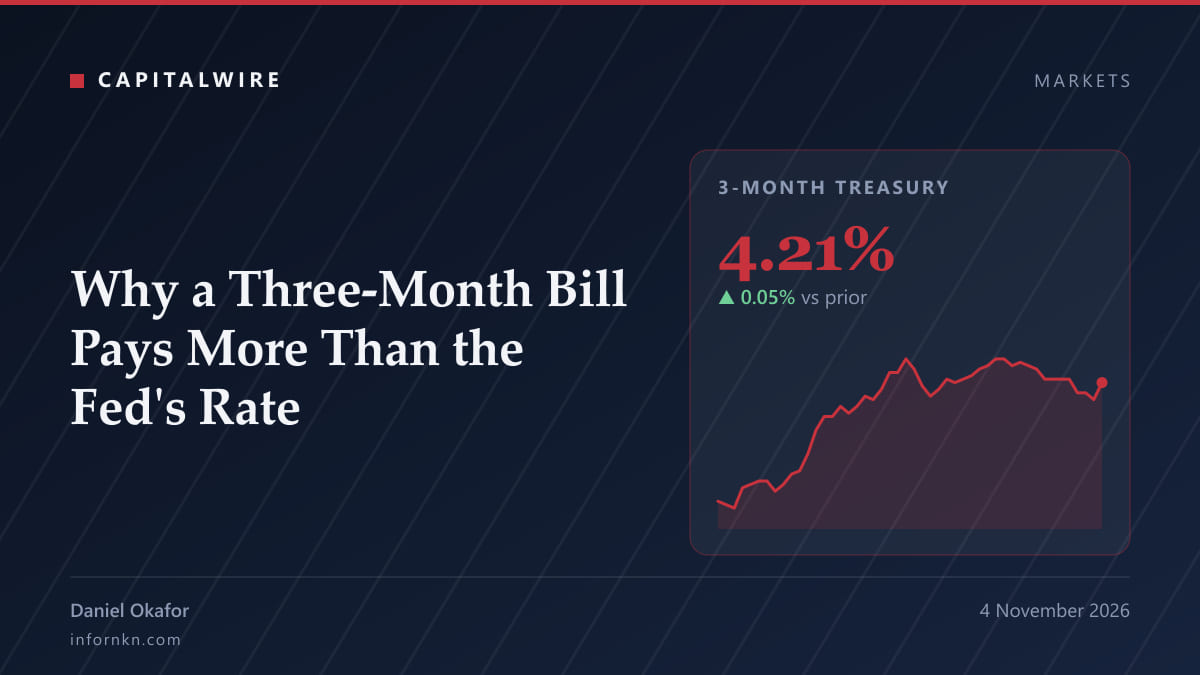
The bill yields 4.21%, the effective funds rate 3.88%. The 33 basis-point gap prices hikes or supply.

The 10-Year's 2026 Rise Is a Real-Rate Story
Nominal yields are up 79 basis points this year. Real yields account for 69 basis points of that, inflation expectations for 9.
Reader discussion